
Missed Insulin Dose in Cats: What to Do Next
By RexVet Team | Reviewed by Dr. Tiffany Delacruz, DVM
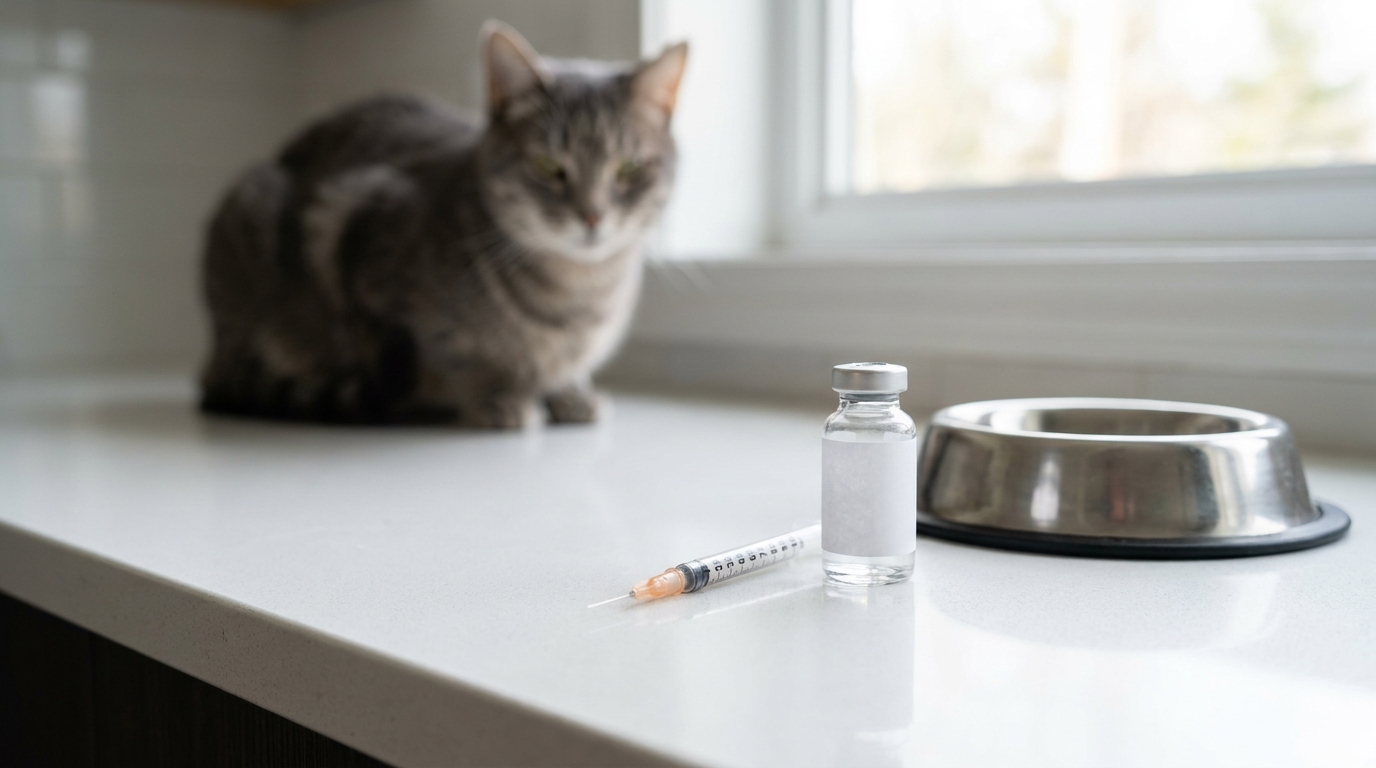
If you missed your cat's insulin dose or are not sure it went in, never repeat it: wait for the next scheduled dose and watch for low blood sugar.
The golden rule: never double dose
A skipped injection is usually a manageable problem. A doubled injection can be a life-threatening one. That difference is the whole reason the safe answer is to wait.
Too much insulin pushes blood sugar down too far, and the Merck Veterinary Manual is blunt about it: overdosing insulin can cause life-threatening low blood sugar. Too little insulin for one cycle mostly means a higher blood sugar for a few hours and a thirstier, hungrier cat: uncomfortable, but not the same order of danger.
So the question "I missed my cat's insulin dose, should I just give it now?" has a deliberately boring answer: no. If you cannot say for certain the injection went in, because she twisted away or you simply cannot remember, treat that dose as given and resume at the next scheduled time. Never give a second dose to cover one you are unsure of. Do not top up a partial injection, and do not change the amount in the syringe to compensate.
Signs of dangerous low blood sugar
Hypoglycemia is what you are watching for, and it usually shows up in the hours after an injection. The signs, roughly in order of how alarming:
- Wobbliness, or an unsteady, drunk-looking walk
- Weakness, lethargy, or trouble making a jump she normally makes
- A glazed, disoriented look, or staring at nothing
- Twitching or trembling
- Sudden intense hunger, pacing, or restlessness
- Vomiting
- Collapse or a seizure
The Cornell Feline Health Center lists weakness, lethargy, vomiting, lack of coordination, seizures and coma among the signs of low blood sugar in a diabetic cat. The early ones are easy to miss. The late ones are not.
If your cat is alert and able to swallow, offer food and call a veterinarian or emergency clinic right away - low blood sugar in a diabetic cat is treated as an emergency, and they may talk you through rubbing a little corn syrup or honey on her gums while you head in. If she does not brighten up within about ten minutes, or she gets worse at any point, drive her in. If she cannot swallow safely, do not put food, syrup or water into her mouth - go straight to an emergency clinic.
What to do if you missed a dose
Typing "I missed my cat's insulin dose" into your phone at eleven at night is an ordinary part of living with a diabetic cat. Here is the sequence:
- Do not give a replacement injection, and do not change the amount in the syringe.
- Write down the time, whether your cat ate, and what you think happened to the dose.
- Feed on the normal schedule if she wants food.
- Watch for the low blood sugar signs above.
- Give the next dose at the normal scheduled time, in the normal amount.
- Call the vet who manages her diabetes if more than one dose in a row was missed, if she is not eating, or if anything looks off.
One missed injection rarely undoes months of good regulation. Several in a row is different: a diabetic cat left without insulin can slide toward ketoacidosis, with vomiting, refusing food, deep lethargy and sometimes a sweet, nail-polish smell on her breath. That needs an in-person exam today, and an emergency clinic if she is also vomiting or will not stand.
Why insulin timing matters with meals
Insulin lowers blood sugar. Food supplies it. That is why the injection is tied to the meal in the first place, and Cornell's feline diabetes guidance notes that many veterinarians recommend feeding at the time of the injection precisely to avoid a dangerous drop in blood glucose.
So a cat who refused her meal is not simply a missed-dose question. Insulin given to a cat who has not eaten has much less to work against, and that is how a routine evening turns into a hypoglycemic one. If she skipped her food, call the vet who manages her diabetes before you inject, and do not decide on your own to give a smaller amount. Changing the amount is a dose change, and that belongs to the vet who set it.
A cat who stops eating is also telling you something separate: dental pain, pancreatitis, kidney disease and early ketoacidosis all show up first as a cat walking away from the bowl. And while most diabetic cats are injected roughly twelve hours apart, drifting by an hour happens to everyone. Stacking two doses close together is the real risk.
Preventing future dosing errors
Almost every double dose starts with the same sentence: "I thought you gave it."
- Keep one shared written log - a sheet on the fridge, or a note both of you can see on your phones. Initial it the moment the needle comes out, not later. This single habit prevents most double dosing.
- Decide who owns each injection. Morning is one person's job, evening the other's, and neither covers without saying so out loud.
- Set an alarm for both times, on the phone of whoever is on duty, and draw up in the same place and the same light each time.
- Use only the syringes your vet dispensed for that insulin. Veterinary and human insulins often call for different syringe types, and swapping them quietly changes how much your cat receives.
- Write the routine down for anyone who covers for you, from a sitter to a boarding facility.
When to seek veterinary guidance
Reach out to a veterinarian if more than one dose in a row was missed, if you are new to insulin and the routine still feels uncertain, if your cat is suddenly drinking and urinating much more or losing weight, or if the twice-daily routine has stopped fitting your days.
Some of these need hands on your cat rather than a screen: if she has not eaten for a day, has vomited more than once, or her breath smells sweet or like nail polish, she needs an in-person exam and bloodwork today.
RexVet is a nonprofit veterinary telehealth practice licensed in Florida, New York and Virginia, and our veterinarians are reachable 24/7. A standard video visit is $64.99, which is a reasonable way to work through a dose you are unsure about, a log that has stopped matching your routine, or a feeding schedule that no longer fits your life. Families have rated the service 4.9 across more than 8,313 reviews.
Be realistic about what video can do for a diabetic cat, though: it is guidance and triage, not a refill counter. A consultation never guarantees a prescription, and Florida law limits telehealth-only prescribing to a 14-day supply that cannot be renewed without an in-person exam, so ongoing insulin stays with the veterinarian who physically examines your cat.
Emergency situations requiring in-person care
Some things cannot be handled over video. Go to an emergency veterinary clinic now, in person, if your cat:
- collapses or cannot stand
- has a seizure, or twitching that will not settle
- is unresponsive, cannot be roused, or stares through you
- cannot swallow
- has received, or may have received, two doses of insulin
- is breathing hard, feels cold, or has hidden somewhere and will not respond to you
Severe hypoglycemia is treated with intravenous glucose and hours of monitoring, and no version of that happens on a screen. Call the clinic while someone else drives, and bring the insulin box and your dosing log: knowing the product and the last confirmed dose changes what the team does first.
Frequently Asked Questions
What should I do if I missed my cat's insulin dose?
Skip the missed dose and give the next one at its normal scheduled time, in the normal amount. Do not give a replacement injection to make up for it, because a double dose is far more dangerous than a missed one.
Feed her as usual if she wants food, watch for wobbliness, weakness, disorientation or twitching, and call the vet managing her diabetes if more than one dose in a row was missed.
How do I stop being unsure whether I already gave the dose?
Keep one shared written log and initial it the second the injection is finished. Uncertainty is a record-keeping problem rather than a memory problem, and no amount of careful recall fixes it at ten at night. Until the log says otherwise, assume the dose was given.
What are the warning signs of low blood sugar in a cat?
Wobbliness, weakness or lethargy, a glazed or disoriented look, twitching, sudden hunger or restlessness, vomiting, collapse and seizures are the signs of hypoglycemia in a cat. If your cat seems even slightly off in the hours after an injection, take it seriously, and treat collapse or a seizure as an in-person emergency.
Can a vet help me manage my cat's insulin routine?
Yes, a veterinarian can review the parts of a diabetic cat's routine that go wrong most often: injection timing, meals, travel, technique, and what to do on a night a dose is missed. Much of what makes feline diabetes stressful is logistics rather than medicine, and working through it before it becomes a crisis is exactly what a consultation is for.
For a household with recurring questions, our $120 Family Plan is a one-time payment covering four visits plus unlimited messaging, and it never auto-renews. RexVet veterinarians are licensed in Florida, New York and Virginia, and a visit is guidance rather than a guaranteed prescription.
Is it okay to give my cat's insulin late?
A late dose is generally safer than a doubled one, so if you are an hour or so behind and your cat has eaten normally, giving it and returning to the usual schedule is reasonable. If you are already close to the next scheduled injection, skip the late one rather than crowding two doses together.
What if I think the insulin went into my cat's fur?
Treat it as given. A wet patch of fur or a faint smell means some of the dose probably missed, but you have no way to know how much went in, and guessing at a replacement injection is how cats end up hypoglycemic.
Note it in the log, feed and watch as usual, and give the next dose on time. If it keeps happening, ask your vet to watch your technique over video.
FAQs
What should I do if I missed my cat's insulin dose?
Skip the missed dose and give the next one at its normal scheduled time, in the normal amount. Do not give a replacement injection to make up for it, because a double dose is far more dangerous than a missed one.
Feed her as usual if she wants food, watch for wobbliness, weakness, disorientation or twitching, and call the vet managing her diabetes if more than one dose in a row was missed.
How do I stop being unsure whether I already gave the dose?
Keep one shared written log and initial it the second the injection is finished. Uncertainty is a record-keeping problem rather than a memory problem, and no amount of careful recall fixes it at ten at night. Until the log says otherwise, assume the dose was given.
What are the warning signs of low blood sugar in a cat?
Wobbliness, weakness or lethargy, a glazed or disoriented look, twitching, sudden hunger or restlessness, vomiting, collapse and seizures are the signs of hypoglycemia in a cat. If your cat seems even slightly off in the hours after an injection, take it seriously, and treat collapse or a seizure as an in-person emergency.
Can a vet help me manage my cat's insulin routine?
Yes, a veterinarian can review the parts of a diabetic cat's routine that go wrong most often: injection timing, meals, travel, technique, and what to do on a night a dose is missed. Much of what makes feline diabetes stressful is logistics rather than medicine, and working through it before it becomes a crisis is exactly what a consultation is for.
For a household with recurring questions, our $120 Family Plan is a one-time payment covering four visits plus unlimited messaging, and it never auto-renews. RexVet veterinarians are licensed in Florida, New York and Virginia, and a visit is guidance rather than a guaranteed prescription.
Is it okay to give my cat's insulin late?
A late dose is generally safer than a doubled one, so if you are an hour or so behind and your cat has eaten normally, giving it and returning to the usual schedule is reasonable. If you are already close to the next scheduled injection, skip the late one rather than crowding two doses together.
What if I think the insulin went into my cat's fur?
Treat it as given. A wet patch of fur or a faint smell means some of the dose probably missed, but you have no way to know how much went in, and guessing at a replacement injection is how cats end up hypoglycemic.
Note it in the log, feed and watch as usual, and give the next dose on time. If it keeps happening, ask your vet to watch your technique over video.
Medically Reviewed
Reviewed by Dr. Tiffany Delacruz, DVM — licensed veterinarian and CEO of RexVet. Last reviewed September 11, 2026.
Content is for informational purposes and does not replace professional veterinary advice.
Chief Executive Officer · Licensed Veterinarian
Dr. Delacruz is a licensed Doctor of Veterinary Medicine specializing in preventive care and veterinary telehealth. She reviews all health content on RexVet to ensure accuracy and clinical relevance.
Sources & References
- · American Veterinary Medical Association — Telehealth Guidelines
- · AVMA — Pet Care Resources
- · U.S. FDA — Animal & Veterinary
Need an Expert Opinion on This Topic?
Connect with a certified vet via video call in minutes
Talk to Vet Now