
Dog Ate a Corn Cob: Blockage Signs and What to Do Now
By RexVet Team | Reviewed by Dr. Tiffany Delacruz, DVM
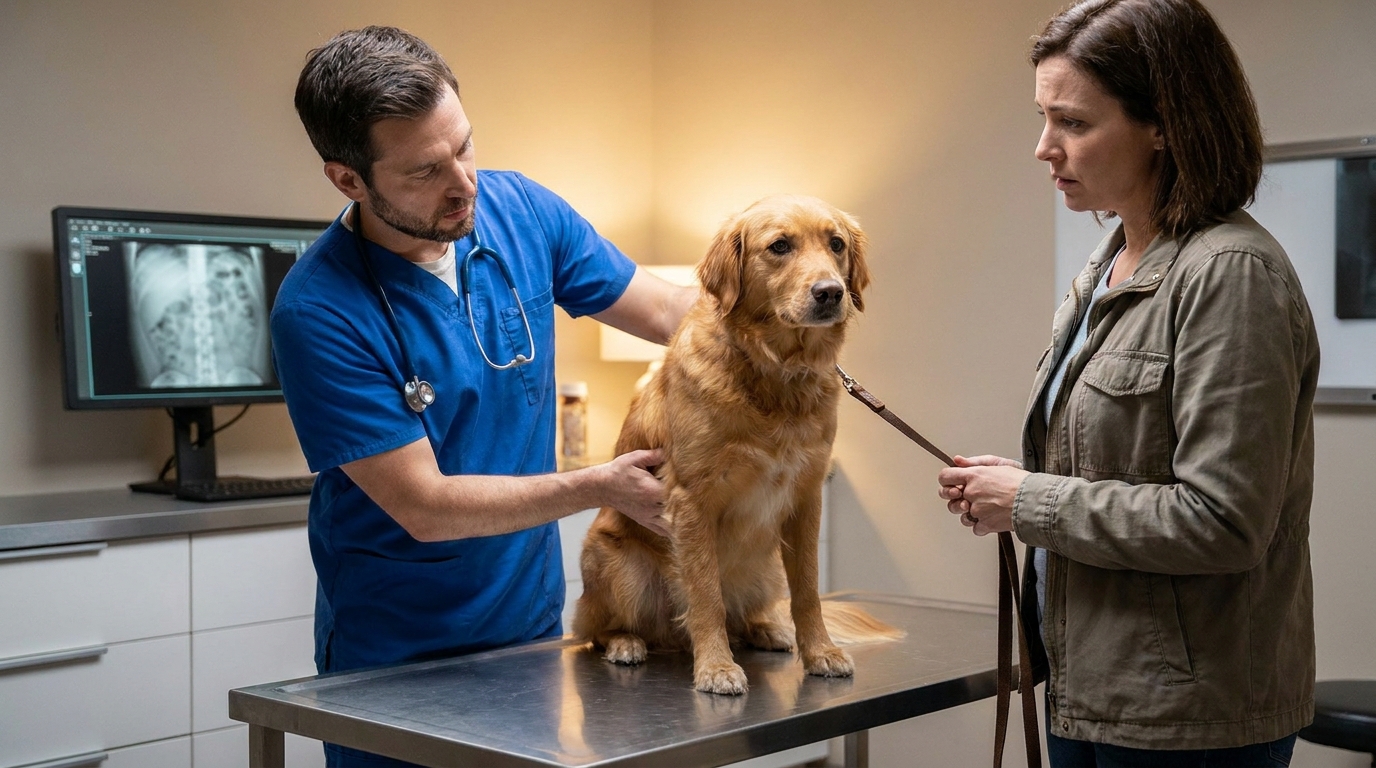
A swallowed corn cob can lodge in a dog's gut while the dog still eats, poops and acts normal. Here are the warning signs and the next steps.
Quick answer: A dog that ate any part of a corn cob needs an in-person vet now for X-rays, even if it seems fine and still poops, because a cob can lodge in the gut. ASPCA Animal Hospital veterinarians say cobs top their list of objects dogs swallow. Any vomiting, not eating, belly pain, straining or a missing corn holder means the ER now. Don't make your dog vomit at home.
This article is general information, not a diagnosis. If you think your pet is in danger, go to the nearest emergency animal hospital.
In person now means your own vet if they can see your dog right away, otherwise an emergency vet.
Go to an emergency vet now if you see these signs
A dog that ate any part of a corn cob needs an emergency vet now if it vomits, retches, stops eating, has a swollen or painful belly, strains with little or no stool, or seems weak. A missing corn holder, or a missing prong from one, means the ER now even with no signs.
Also go now for:
- Belly pain: a hunched back, the prayer position (front legs down, rear end up), or growling when the belly is touched.
- Drooling, gagging, repeated swallowing or bringing food back up: the FDA warns that corn cobs can get stuck in a pet's esophagus, stomach or intestines.
- Choking signs: pawing at the mouth, struggling to breathe, blue or gray gums, or collapse.
- On-and-off vomiting, or water that won't stay down, even small sips.
- Dry heaving with a swollen belly, especially in a large, deep-chested dog; this can also be bloat.
- Pale, white or gray gums, weakness or collapse, fast breathing, a fever or a body that feels cold, red or coffee-ground vomit, or black, tarry stool.
- Tremors, wobbliness or a seizure after a trash or leftovers raid; call a poison line on the way.
If the cob had garlic, onion or herb butter or seasoning on it, or your dog has tremors, wobbliness or a seizure, call a poison line on the way to the vet, not instead of going: ASPCA Animal Poison Control at (888) 426-4435 (a consultation fee may apply) or Pet Poison Helpline at (855) 764-7661 (a per-incident fee applies). For other swallowed objects, see intestinal blockage in dogs.
What should I do right now if my dog ate a corn cob?
If your dog ate a corn cob, take the rest of the corn away, count the cobs and corn holders, note the time, and get your dog seen in person now.
- Check each corn holder for missing prongs; a missing holder or prong means the ER now.
- Note how much cob is missing, and whether it had butter, garlic, onion or foil.
- Call ahead on the way, and bring the cob ends or a photo.
- Don't make your dog vomit, don't reach down the throat, and don't feed anything to push the cob through.
Pulling a piece out of the mouth does not mean the whole cob is out. In a 2014 ASPCA news story, the owner of Frost, a one-year-old pit bull, pulled something from the dog's mouth and thought it was all gone, but Frost vomited that night; an ultrasound showed a corn cob blockage, removed in a two-hour surgery.
If your own vet is closed for Thanksgiving (Thursday, Nov. 26), in person now usually means an emergency hospital; see vet closed on Thanksgiving or Christmas.
My dog ate a corn cob but is acting fine and still pooping. Is that OK?
No: a dog with a corn cob inside can act normal and keep pooping, so it still needs an in-person vet now. The Merck Veterinary Manual says a dog with a blockage can have a normal physical exam. A dog may also keep pooping for a short time with part of a cob stuck.
In a case series of 72 dogs with swallowed objects from Naples, Italy (Di Palma and colleagues, Animals, 2022), only 31% had stopped passing stool. Merck adds that vomiting may be less common when the blockage sits farther down the small intestine.
After a corn cob swallow, or a possible one:
| What you see | Why it matters | Do this |
|---|---|---|
| Seems fine | Can still be stuck | In person now |
| Any vomiting | Often upper gut | ER now |
| On-and-off vomiting | Can be partial | ER now |
| Gagging, drooling | May be stuck high | ER now |
| Straining, no stool | Can be blocked | ER now |
| Dry retching, big belly | Bloat or block | ER now |
| Pale gums, weak | Possible shock | ER now |
In person now means your own vet if they can see your dog right away, otherwise an emergency vet.
Will a dog pass a corn cob, and how long can it stay in the stomach?
Don't wait for a corn cob to pass: a dog usually can't pass a cob on its own, and the Merck Veterinary Manual says an endoscope can usually remove an object only while it is still in the stomach; once it moves into the intestine, surgery is usually needed.
No one can predict how long a cob will stay in the stomach, so never wait at home. Merck describes a 36- to 48-hour watch only for some small, smooth objects in a stable dog, with repeat X-rays in the hospital. A corn cob is neither small nor smooth, and Merck recommends removing most swallowed objects. In the Naples series, 68% of objects were still in the stomach, and an endoscope removed 56% of all objects.
Kernels, cob or corn holder: which parts are dangerous?
Plain kernels cut off the cob are usually fine for a dog in small amounts, the American Kennel Club says, but the cob and the corn holder are not.
| Item | Risk | Do this |
|---|---|---|
| Plain kernels | Usually OK | Watch |
| Whole cob | Can block | In person now |
| Chewed piece | Can block | In person now |
| Corn holder | Sharp prongs | ER now |
| Buttered cob | Fat too | In person now |
| Garlic butter | Onion family | Poison line now |
| Foil wrap | Food inside | In-person vet today |
Any cob swallowed with garlic butter or foil still means in person now; call a poison line on the way for garlic or onion.
A missing corn holder is handled like a missing skewer; see dog ate a toothpick or skewer. After a buttered cob, add the 4-day pancreatitis watch in dog ate grease, butter or fat to the in-person visit, never in place of it. Foil-wrapped grilled corn can add a foil swallow; see dog ate aluminum foil with food on it.
If only plain kernels were eaten and every cob and holder is accounted for, refusing food, vomiting with diarrhea or a puppy with diarrhea means an in-person vet today, and vomiting more than once means an emergency vet now.
How long after eating a corn cob do signs start?
A dog that ate a corn cob can show signs within hours, or signs can come and go for days with a partial blockage, so a quiet first night is not an all-clear. Go in person now rather than waiting for signs; any vomiting, not eating, belly pain, straining or weakness means an emergency vet now.
Does my dog's size change the plan?
No: every dog that swallowed any part of a corn cob needs an in-person vet now, whatever its size. Medium and large dogs may swallow big pieces whole, and choking can happen, especially in smaller breeds.
The Merck Veterinary Manual says young large-breed dogs are more likely than older animals to get a blockage, and it shows an X-ray of a 2-year-old Labrador Retriever with a corn cob stuck in the small intestine. Small dogs are not exempt: 22% of the Naples dogs weighed under 9 kg (about 20 pounds). A puppy that ate anything from a cob goes in person now.
My dog threw up the corn cob. Is it over?
No: a dog that vomits after swallowing a corn cob needs an emergency vet now, because more pieces may still be inside. Vomiting is also a main blockage sign: 82% of the Naples dogs vomited. Bring a photo of what came up, and don't give food or human stomach medicine.
What will the vet do, and what does it cost?
A vet usually takes X-rays of a dog that ate a corn cob, may add ultrasound, and may try an endoscope for a cob still in the stomach, with surgery if that fails or once the cob has moved into the intestine, according to the Merck Veterinary Manual and Cornell University. Cornell's Riney Canine Health Center lists corn cobs among the common objects that block a dog's gut and says the best outcomes come when the blockage is found and removed promptly.
Pet Poison Helpline notes that a corn cob can be hard to see on X-rays, so a clear first X-ray does not always rule it out; a vet may add ultrasound or contrast X-rays, and Cornell says surgery may be needed to confirm when suspicion stays high. A heavy cob sometimes can't be lifted out with an endoscope.
Merck says removal has a high survival rate, and the American College of Veterinary Surgeons (ACVS) says the prognosis after surgery is usually quite good. The ASPCA says surgery like this can cost thousands of dollars, so ask for an estimate. After surgery, call the surgeon or go to an ER now for any vomiting, or a worse appetite, lethargy, fever, a draining incision or a swelling belly in the first 5 days; ACVS says a leak can happen in that window.
How to keep corn cobs away from your dog at Thanksgiving and cookouts
Put corn cobs straight into a lidded outside bin, not the kitchen trash, and never leave them on plates, because veterinarians at the ASPCA Animal Hospital say corn cobs top their list of objects dogs swallow.
- Ask guests to pull out corn holders and hand you their cobs; count the holders after the meal.
- Keep plates off low tables, and bin the foil from grilled corn with the cob.
- For a repeat swallower, ACVS suggests a room or crate with no loose objects, and a basket muzzle.
For the rest of the meal, see Thanksgiving foods dogs can and cannot eat.
When a video visit helps and when it does not
A video visit cannot find, rule out or remove a swallowed corn cob in a dog, because it cannot see inside the gut, so a dog that may have swallowed any part of a cob needs an in-person vet now, even if it is eating, pooping and acting normal. A missing corn holder, or any vomiting, not eating, belly pain, straining or gagging after a possible cob swallow, means an emergency vet now, with a poison line on the way for garlic or onion butter.
RexVet, a nonprofit online vet service, serves pets located in Florida, New York and Virginia by video visit. It is a 501(c)(3) organization. A $64.99 live video visit is with a licensed RexVet vet, a veterinarian licensed in your pet's state, with your pet located there during the visit. It fits only when: (1) a bright adult dog ate only plain kernels cut off the cob, every cob and corn holder is accounted for, no garlic or onion butter was involved, and the dog is still eating, had one soft stool or one vomit, keeps water down, and has a soft belly and normal breathing; (2) your dog has already been seen in person and you want to go over the plan; or (3) after blockage surgery, the surgical clinic or its after-hours line can't be reached, and your dog is alert, eating as expected, not vomiting and has a dry incision, so the veterinarian can review the discharge sheet alongside the surgeon's plan, not instead of it. If one of these fits, you can book a video visit.
On camera, the veterinarian can check your dog's energy, posture, breathing, gum color and belly shape and tell you whether to go in now; they cannot take X-rays, run an ultrasound, feel the belly, give fluids, use an endoscope or operate. No prescription is promised; any medicine is the veterinarian's decision after the visit, within state and federal rules. Live slots run about 8 AM to 11 PM ET, and a same-day slot is not guaranteed; outside those hours, if no slot is open, or if anything is getting worse, go to an emergency vet.
Need an Expert Opinion on This Topic?
Book a video visit with a licensed vet, evenings and weekends included
See open timesFrequently Asked Questions
Can dogs eat corn on the cob?
No. Corn on the cob is not safe for dogs, though plain kernels cut off the cob are usually fine in small amounts, the American Kennel Club says. AKC advises against buttered corn because of the butter, salt and seasonings. If your dog already ate any part of a cob, get your dog seen in person now.
How long does it take a dog to pass a corn cob?
Don't wait: a dog usually can't pass a corn cob on its own, so get your dog seen in person now for X-rays. There is no safe number of hours to wait at home; the Merck Veterinary Manual's 36- to 48-hour watch applies only to small, smooth objects followed with X-rays in the hospital. Go to an emergency vet now if your dog vomits, stops eating, has belly pain or strains.
Should I make my dog throw up after eating a corn cob?
No. Don't make your dog throw up at home after eating a corn cob. Pet Poison Helpline warns that a sharp or large object can get stuck or damage the esophagus on the way back up, so only a vet should decide, in the clinic. If your dog has already vomited, go to an emergency vet now, because more pieces may still be inside.
My dog ate a small piece of corn cob. Is that OK?
No: any piece of corn cob, even a small chewed one, means an in-person vet now for X-rays, even if your dog seems fine. The American Kennel Club notes that dogs may swallow pieces of the cob, not just the whole cob, and the Merck Veterinary Manual says a dog with a blockage can have a normal physical exam.
Can I give my dog bread, pumpkin or oil to help a corn cob pass?
No. Don't give bread, pumpkin, oil, fiber, laxatives or an enema to push a corn cob through, and don't withhold water as home care; get your dog seen in person now. Skip leftover anti-nausea tablets and human stomach, antacid or anti-diarrhea medicine too: the FDA-approved label of a common canine anti-nausea tablet says its safe use has not been evaluated in dogs with a gut blockage.
Can a dog die from eating a corn cob?
Yes, it can: the ASPCA warns that swallowed objects can be fatal. The Merck Veterinary Manual calls a gut blockage an emergency and says removal has a high survival rate. In a Naples case series of 72 dogs with swallowed objects, every dog whose object was removed from the stomach survived, and vomiting for more than 24 hours before treatment was linked to a worse outcome, a reason to go in now, not a safe waiting window.
Can an online vet tell if my dog has a corn cob stuck?
No. A video visit can't find or rule out a swallowed corn cob, so a dog that ate one needs X-rays in person now. For a pet located in Florida, New York or Virginia, a video visit fits only when no cob or corn holder could have been swallowed: a licensed RexVet vet can check your dog on camera and say whether to go in, but X-rays, ultrasound, a hands-on belly exam, an endoscope and surgery need an in-person or emergency vet. No prescription is promised. If medicine comes up for something else: in Florida (s.474.2021), a prescription after a video-only visit is limited to FDA-approved animal drugs used as labeled, for up to 14 days (1 month for products labeled only for fleas and ticks), with no renewal without an in-person exam; human-labeled drugs, controlled drugs and compounded antibacterial, antifungal, antiviral or antiparasitic drugs need an in-person exam. Federal rules require an in-person exam before any vet prescribes a human or off-label drug. In Virginia, the exam behind a prescription may be done electronically, but the veterinarian still decides whether video is enough. New York's rules for veterinary video care, including prescribing, are not settled, so a visit there may cover less. RexVet is not a pharmacy; a pharmacy transfer fee applies if a prescription is sent to an outside pharmacy.
FAQs
Can dogs eat corn on the cob?
No. Corn on the cob is not safe for dogs, though plain kernels cut off the cob are usually fine in small amounts, the American Kennel Club says. AKC advises against buttered corn because of the butter, salt and seasonings. If your dog already ate any part of a cob, get your dog seen in person now.
How long does it take a dog to pass a corn cob?
Don't wait: a dog usually can't pass a corn cob on its own, so get your dog seen in person now for X-rays. There is no safe number of hours to wait at home; the Merck Veterinary Manual's 36- to 48-hour watch applies only to small, smooth objects followed with X-rays in the hospital. Go to an emergency vet now if your dog vomits, stops eating, has belly pain or strains.
Should I make my dog throw up after eating a corn cob?
No. Don't make your dog throw up at home after eating a corn cob. Pet Poison Helpline warns that a sharp or large object can get stuck or damage the esophagus on the way back up, so only a vet should decide, in the clinic. If your dog has already vomited, go to an emergency vet now, because more pieces may still be inside.
My dog ate a small piece of corn cob. Is that OK?
No: any piece of corn cob, even a small chewed one, means an in-person vet now for X-rays, even if your dog seems fine. The American Kennel Club notes that dogs may swallow pieces of the cob, not just the whole cob, and the Merck Veterinary Manual says a dog with a blockage can have a normal physical exam.
Can I give my dog bread, pumpkin or oil to help a corn cob pass?
No. Don't give bread, pumpkin, oil, fiber, laxatives or an enema to push a corn cob through, and don't withhold water as home care; get your dog seen in person now. Skip leftover anti-nausea tablets and human stomach, antacid or anti-diarrhea medicine too: the FDA-approved label of a common canine anti-nausea tablet says its safe use has not been evaluated in dogs with a gut blockage.
Can a dog die from eating a corn cob?
Yes, it can: the ASPCA warns that swallowed objects can be fatal. The Merck Veterinary Manual calls a gut blockage an emergency and says removal has a high survival rate. In a Naples case series of 72 dogs with swallowed objects, every dog whose object was removed from the stomach survived, and vomiting for more than 24 hours before treatment was linked to a worse outcome, a reason to go in now, not a safe waiting window.
Can an online vet tell if my dog has a corn cob stuck?
No. A video visit can't find or rule out a swallowed corn cob, so a dog that ate one needs X-rays in person now. For a pet located in Florida, New York or Virginia, a video visit fits only when no cob or corn holder could have been swallowed: a licensed RexVet vet can check your dog on camera and say whether to go in, but X-rays, ultrasound, a hands-on belly exam, an endoscope and surgery need an in-person or emergency vet. No prescription is promised. If medicine comes up for something else: in Florida (s.474.2021), a prescription after a video-only visit is limited to FDA-approved animal drugs used as labeled, for up to 14 days (1 month for products labeled only for fleas and ticks), with no renewal without an in-person exam; human-labeled drugs, controlled drugs and compounded antibacterial, antifungal, antiviral or antiparasitic drugs need an in-person exam. Federal rules require an in-person exam before any vet prescribes a human or off-label drug. In Virginia, the exam behind a prescription may be done electronically, but the veterinarian still decides whether video is enough. New York's rules for veterinary video care, including prescribing, are not settled, so a visit there may cover less. RexVet is not a pharmacy; a pharmacy transfer fee applies if a prescription is sent to an outside pharmacy.
Medically Reviewed
Reviewed by Dr. Tiffany Delacruz, DVM — licensed veterinarian and CEO of RexVet. Last reviewed November 12, 2026.
Content is for informational purposes and does not replace professional veterinary advice.
Chief Executive Officer · Licensed Veterinarian
Dr. Delacruz is a licensed Doctor of Veterinary Medicine specializing in preventive care and veterinary telehealth. She reviews all health content on RexVet to ensure accuracy and clinical relevance.
Sources & References
- · American Veterinary Medical Association — Telehealth Guidelines
- · AVMA — Pet Care Resources
- · U.S. FDA — Animal & Veterinary