
Dr. Tiffany Delacruz, DVM • Chief Executive Officer, RexVet • 2026-06-28 • 11 min read
Dog Drinking Too Much Water? Vet's FL, NY & VA Guide to Polydipsia
Excessive thirst in dogs is rarely just thirst. 7 causes including kidney disease, diabetes and Cushing's — and when to test. FL, NY and VA vets.
Medically reviewed by Dr. Tiffany Delacruz, DVM
A dog drinking too much water is one of the most common things pet parents notice — and one of the most commonly dismissed. This guide is written for dog parents in Florida, New York, and Virginia. It walks through what's normal, the 7 real causes of polydipsia, what diagnosis actually looks like, and how telehealth fits.
What's normal water intake?
- Healthy dogs drink roughly 1 ounce of water per pound of body weight per day
- A 25-pound dog: ~25 oz/day (about 750 mL)
- A 50-pound dog: ~50 oz/day (about 1.5 L)
- An 80-pound dog: ~80 oz/day (about 2.4 L)
- Hot weather, exercise, dry food, and lactation all increase normal intake — context matters
- Polydipsia threshold: more than 100 mL/kg/day (or 1.5x baseline) is abnormal
The 7 causes of true polydipsia
- Chronic kidney disease (CKD) — kidneys can't concentrate urine, so dog drinks to keep up
- Diabetes mellitus — high blood sugar pulls water into urine; dog drinks to compensate
- Cushing's disease (hyperadrenocorticism) — excess cortisol drives thirst directly
- Diabetes insipidus (rare) — pituitary or renal — water regulation defect
- Liver disease — affects water balance
- Pyometra (intact females) — uterine infection drives thirst
- Medications — prednisone, furosemide, phenobarbital
- Hot weather + exercise — context-driven, not pathologic
Red flags that mean urgent vet
- Sudden onset polydipsia + lethargy + vomiting — possible kidney failure, pyometra, or DKA (diabetic ketoacidosis)
- Polydipsia + collapse
- Polydipsia + recurrent UTIs (Cushing's often presents this way)
- Polydipsia + sudden hair loss + pot belly + panting (classic Cushing's triad)
- Polydipsia in an intact female + vaginal discharge — pyometra is a surgical emergency
The diagnostic workup
Start with the basics:
- CBC + Chemistry panel — screens kidney, liver, glucose, electrolytes
- Urinalysis with specific gravity — dilute urine (USG <1.030) + polydipsia = inability to concentrate
- T4 — rules out hyperthyroidism (uncommon in dogs)
- Urine cortisol:creatinine ratio — screens Cushing's
- If Cushing's suspected: low-dose dexamethasone suppression test OR ACTH stim test
- If diabetes: fructosamine + urine glucose
- Abdominal ultrasound — pyometra screen + adrenal evaluation
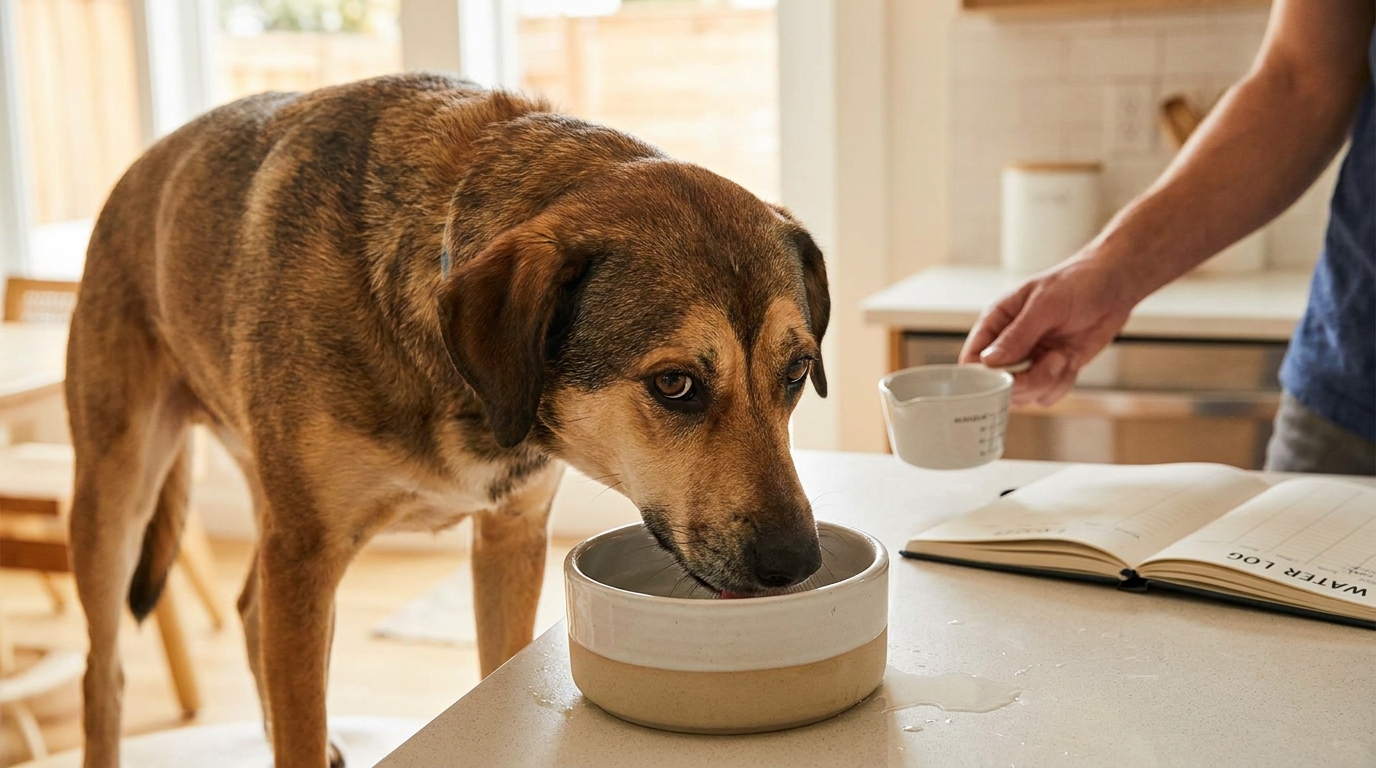
How to measure water intake at home
Before the vet visit, document baseline:
- Use a measuring cup to fill the water bowl
- Note volume at fill time + remaining at refill time
- Track for 3-5 consecutive days
- Photograph the volume measurements
- Note any context: hot day, post-exercise, new food, new medication
- Bring this data to the vet — it speeds up diagnosis significantly
Treatment by cause
- CKD: prescription kidney diet, ACE inhibitor, phosphorus binder, subcutaneous fluids at home for advanced cases
- Diabetes: insulin (usually Vetsulin or NPH), glucose curves, dietary management
- Cushing's: Vetoryl (trilostane) — daily oral medication, requires periodic ACTH stim monitoring
- Diabetes insipidus: desmopressin (DDAVP) eye drops
- Pyometra: surgical (spay) — emergency in most cases
- Medication-induced: review whether the inciting drug can be tapered or substituted
Florida: heat + senior + polydipsia overlap
Florida senior dogs often have multiple causes overlapping. Heat drives normal-but-elevated drinking; CKD becomes harder to distinguish from heat-driven thirst. Baseline measurements in cool months matter for FL dogs. Cushing's is over-represented in middle-aged FL dogs.
New York: medication-induced polydipsia
NY dogs on prednisone for allergies often present with polydipsia as a side effect — typically resolves when prednisone tapers. NYC dogs on furosemide for heart disease will be polydipsic by design. Distinguish drug-induced from pathologic polydipsia by reviewing the medication list first.
Virginia: tick disease + polydipsia
VA dogs with tick-borne disease can develop polydipsia secondary to kidney involvement (Lyme nephritis, Ehrlichia, Anaplasma). VA dogs with new polydipsia and outdoor exposure should be screened with a 4Dx + tick panel alongside the standard polydipsia workup.
How telehealth fits
$64.99 RexVet video visits with FL/NY/VA-licensed vets work well for: chronic disease management (CKD, diabetes, Cushing's) — refill requests and Vetoryl prescriptions (where state rules allow), ACE inhibitor management, dietary coaching, monitoring schedules. Initial diagnosis usually needs in-person bloodwork + urine + sometimes ultrasound. Once the diagnosis is established, most ongoing management is telehealth.
Emergency signals
When to contact a veterinarian
- Sudden polydipsia + lethargy + vomiting — possible kidney failure or DKA
- Polydipsia + collapse
- Polydipsia in intact female + vaginal discharge — pyometra (surgical emergency)
- Polydipsia + pot belly + panting + hair loss — classic Cushing's signs
- Polydipsia + recurrent UTIs
- Polydipsia + sudden weight loss
Frequently asked questions
How much water is too much for a dog?
Normal is roughly 1 oz per pound of body weight per day. More than 100 mL/kg/day (about 1.5x baseline) is abnormal. A 50-pound dog drinking consistently over 75-80 oz/day deserves evaluation.
What causes excessive thirst in dogs?
The 'big three': chronic kidney disease, diabetes mellitus, Cushing's disease. Less common: diabetes insipidus, liver disease, pyometra (intact females), medications (prednisone, furosemide). RexVet FL/NY/VA-licensed vets can help triage and order workup.
Can a RexVet online vet diagnose polydipsia?
We can triage symptoms, review your at-home water intake measurements, and explain what testing is needed. The actual diagnosis requires in-person bloodwork + urinalysis. Once diagnosed, RexVet handles chronic management (refill requests where state rules allow, dietary coaching, monitoring) by $64.99 video visit.
Is Cushing's hard to treat?
Cushing's is manageable but requires lifelong daily Vetoryl (trilostane) and periodic ACTH stim test monitoring. Most dogs do well with proper management. Side effects are real (electrolyte changes, GI upset) so periodic bloodwork matters. RexVet FL/NY/VA-licensed vets manage long-term Cushing's patients by telehealth.
How do I measure my dog's water intake?
Use a measuring cup to fill the bowl. Note volume at fill, remaining at refill. Track 3-5 days. Bring this data to the vet — it accelerates the workup significantly.
Continue reading
Related guides

Best Dog Food for Senior Dogs (2026): What Vets Look For
Vet guide to the best dog food for senior dogs in 2026: AAFCO labels, calories, protein, joint and kidney support, and when a prescription diet is needed.

Traveling With Your Dog: The 2026 Vet Checklist
A DVM's 2026 checklist for traveling with your dog: health certificate timing, car and air safety, motion sickness, packing and travel anxiety.

Online Vet Prescription Refills — Florida, New York, Virginia | $64.99 Video Visit
Refills for your dog or cat's oral and topical medications over a $64.99 video visit with a licensed FL, NY or VA vet, when the vet prescribes.
About the author

Dr. Tiffany Delacruz, DVM
Chief Executive Officer, RexVet
Licensed veterinarian and CEO of RexVet (Rex Vets Inc.). Practicing across Florida, New York, and Virginia via licensed telehealth. Reviews every clinical article on RexVet before publication.